
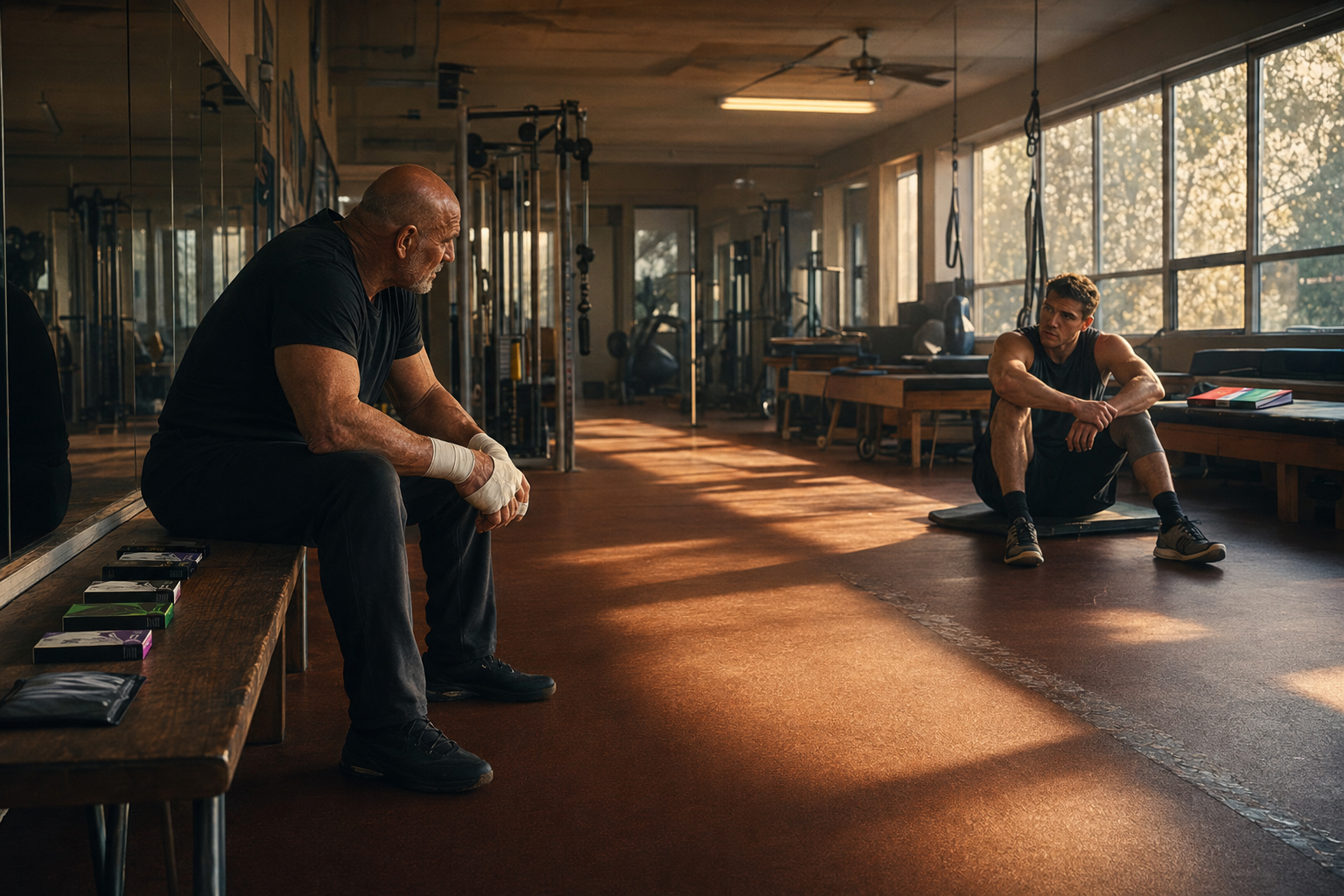
The physical therapy room at Lakeview Sports Medicine smelled like rubber mat and liniment oil and the ghost of ten thousand mornings exactly like this one. The overhead fluorescent above the free weight rack had been threatening to go out for three weeks — it flickered on the hour, every hour, like a nervous tic nobody had gotten around to fixing. The rubber flooring was the color of old pennies, worn pale in the paths between the cable machines and the treatment tables where the traffic was heaviest. Someone had taped a hand-lettered sign above the water fountain that read HYDRATE OR HIBERNATE, the letters starting confident and running out of room so that HIBERNATE crowded up against the wall at a slight downward angle. A ceiling fan turned slowly overhead, pushing the warm air in lazy circles that smelled faintly of eucalyptus from the ultrasound gel warming in its dispenser on the counter.
At six twenty-three in the morning, the room held exactly two people and the particular silence of serious work being done without an audience.
Darius came in first, the way he always did — bag over one shoulder, the other hand already unzipping it before he cleared the doorway, moving with the unconscious physical confidence of an athlete who has never once in his life had to think about how to enter a room. Twenty-six years old. One hundred eighty-seven pounds of fast-twitch muscle and controlled aggression that his coaches had spent four years teaching him to point in the right direction. Eight weeks out from ACL reconstruction on his left knee, which his physical therapist described as "progressing beautifully" and which Darius privately described as "behind schedule" — a difference of perspective that said everything about who he was and how he had gotten where he was.
He dropped his bag on the bench along the mirrored wall, pulled out his protocol binder — color-coded tabs, laminated pages, a system he had built with the same meticulous intensity he brought to his fight camps — and began his morning mobility work on the mat nearest the window. Outside, the parking lot was still mostly empty. A single crow sat on the light pole at the far end, watching the morning arrive with the patience of something that had nowhere else to be.
Darius did not notice the other man for several minutes.
When he did, it was because the bench at the far end of the room creaked under shifting weight — a deep, settled sound, like a dock adjusting to the tide — and Darius looked up from his hip flexor stretch to find that the room had acquired an occupant he had somehow missed entirely.
The man was big in a way that the word big doesn't quite cover. Not bodybuilder big, not the kind of size that comes from a structured relationship with a squat rack and a macro spreadsheet. This was accumulated big — the size that thirty years of physical work builds into the frame the way weather builds into stone, slowly and permanently and without any particular vanity about the result. He was somewhere in his early sixties, with a face that had been handsome once and was still striking in the way that weathered things are striking — every line earned, every crease a record of something that had actually happened. His hair was silver at the temples and gone on top, and he wore it with the complete indifference of a man who had stopped having opinions about it sometime around his forty-fifth birthday. His hands were already wrapped in athletic tape, white and neat and precise, the wrapping of someone who had been doing this particular task for so long it had become as automatic as breathing. He was sitting with his forearms resting on his knees, looking at the middle distance with the calm, unhurried expression of a man waiting for something he knew was coming and wasn't in any rush to meet.
On the bench beside him, three small flat boxes sat in a neat row.
"ACL?" he said. Not looking up. His voice was the kind of voice that had spent decades projecting to the back of arenas — deep and unhurried and carrying further than it seemed like it should at that conversational volume.
Darius glanced over from his stretch. "Eight weeks post-op."
"Which surgeon?"
He told him.
The old man turned the name over for a moment, the way you turn a tool over in your hand to check its quality. Then nodded, a single slow dip of the chin. "Good hands. Solid technique. You'll be fine if you let the process run."
"I'm not stopping the process."
"I didn't say stopping." The old man's eyes moved to the laminated binder on the bench. Back to Darius. The expression on his face was not unkind. It was the expression of a man who has seen a specific thing happen many times and recognizes it on approach, the way a farmer recognizes weather. "I said let it run."
The crow outside shifted on the light pole. The ceiling fan made its slow revolution. The fluorescent light flickered once and held.
"I've had four knee surgeries," the old man said, going back to the careful inspection of his wrapped hands, flexing each finger in sequence the way a pianist checks the keyboard before a performance. "Two shoulder reconstructions. A sternum separation in Indianapolis in 1999 that three different doctors independently described as career-ending, which I found irritating because I had eleven more years of career left in me at the time and I wasn't interested in their timeline." He pressed his thumb against the base of his ring finger, checking the tension in the tape. Satisfied, he moved to the next. "Thirty-one years wrestling professionally. Small promotions in the beginning, territories, then the big stages. I've taken falls on concrete with a quarter inch of padding over it. I've had my knee hyperextended by a man who outweighed me by sixty pounds and didn't realize what he was doing until it was already done. I've worked through things I should not have worked through and paid the compound interest on that decision for years afterward." He looked up. "So when I say let the process run, I'm not repeating something I read. I'm telling you what the alternative taught me."
Darius's PT wasn't due for another thirty-five minutes. He sat down on the mat, his knee extended in front of him, and said the only thing that actually mattered in rooms like this one when someone with that much earned authority was talking.
"What do you take?"
Vincent — that was his name, Vincent Caruso, though he had wrestled as The Sovereign, as Big Vince Malone, as The Architect depending on the decade and the character the bookers needed — reached over to the bench beside him and touched the first of the three boxes with one taped finger, the way a jeweler indicates a particular stone without picking it up.
"Every morning," he said. "Before I do anything else. Before coffee, before I check my phone, before I even fully decide to be awake. This one first."
He picked it up and held it where Darius could see it. GRW. Immune growth and resilience. Thirteen botanicals pulled from six countries — Astragalus root from the highlands of Mongolia, Reishi mushroom from the forests of East Asia, Echinacea from the American plains, Bitter Melon, Olive leaf, Black Currant, Ashwagandha. The formula was built around a single understanding that took Vincent three decades to arrive at on his own and that he now wished someone had handed him at twenty-three in a gym that smelled exactly like this one: a body under sustained physical stress has an immune and inflammatory response system that is working overtime every single day, and if you don't actively support it, it will eventually start pulling from reserves it cannot afford to spend.
"Thirteen botanicals," Vincent said. "Every one of them chosen for a specific reason. Reishi mushroom has been used in eastern medicine for two thousand years as an immune modulator — not a stimulant, a modulator, which means it helps the system respond appropriately instead of either over- or under-reacting. Astragalus has clinical research behind its effect on inflammatory pathways that is substantial enough that it shows up in oncology literature. Echinacea you've heard of. Most people think of it as a cold remedy and stop there. The actual research on its effect on natural killer cell activity goes considerably further than that." He set the box down with the quiet authority of a man presenting evidence rather than making a sales pitch. "I take this because at sixty-two years old with the history that's in my body, my immune system and my inflammatory response need daily intentional support. Not when I'm sick. Every day. The way you maintain an engine, not the way you call a mechanic."
He moved to the second box. AIR. Eleven botanicals from five continents — Black Currant, Maca from the Peruvian Andes, African White Aloe from the Eastern Cape, Rosa Majalis from the Siberian highlands, Goji from the Himalayan plateau, Amla from the Indian subcontinent, Cranberry, Lemon, Vitamin C, Vitamin D, Zinc Citrate. The formula addressed what Vincent had come to think of as the invisible infrastructure — the respiratory and immune architecture that nobody talks about until it fails.
"You think about your cardio," he said. "You think about your VO2, your recovery heart rate, your gas tank in the third round. You don't think about the deeper system underneath all of that — the cellular environment your respiratory function is operating in, the immune scaffolding that determines how fast your body clears the inflammation from a hard training session, the infrastructure that either lets your other supplements work the way they're supposed to or quietly cancels out half of what they're trying to do." He tapped the AIR box. "I didn't start thinking about this until my late forties. By then I had already spent twenty-five years training hard in environments that were demanding everything from that system without giving it anything back. If I had started at your age —" He stopped. Shook his head once, a small private motion. "Different conversation."
Then he reached into the bag and produced something different from the first two. Not a box exactly — a flat black packet, the size of a deck of cards, matte finish with white and purple lettering that caught the morning light coming through the rehab room window in a way that made it look almost lit from within. He set it on the bench between the other two boxes with a deliberateness that made Darius lean forward without meaning to.
NMN.
"This one," Vincent said, and something shifted in his voice — not softer exactly, but more particular, the way a person's voice changes when they're about to tell you something they genuinely wished they had known sooner, "is the one that changed the conversation for me three years ago. And I'll be honest with you — I'm still a little angry that nobody mentioned it until I was fifty-nine."
The ceiling fan turned. The crow outside had been joined by two more, all three of them now arranged on the light pole in a descending row like a visual footnote. The fluorescent bulb flickered at six forty-one, right on schedule, and held.
Nicotinamide mononucleotide. The most direct precursor to NAD+ the human body has. NAD+ — nicotinamide adenine dinucleotide — is the molecule that sits at the absolute center of cellular energy production. It is what the mitochondria run on. It is what the DNA repair enzymes require to function. It is the molecule that determines how efficiently a cell converts fuel into usable energy, how quickly damaged tissue identifies and addresses the damage, how effectively the body's recovery systems run their overnight maintenance cycle while an athlete sleeps.
At twenty-five, the average person's NAD+ levels are near their lifetime peak. By fifty, they've dropped by roughly half. By sixty, the drop is steeper. The cells are still trying to do everything they were built to do — repair, recover, produce energy, maintain the structural integrity of the tissue — but they're doing it with significantly less of the molecular fuel the process requires. The body doesn't announce this. It just gets slower. Harder. The recovery that used to take a day starts taking three. The sharpness that used to be automatic requires more effort to access. The gap between how you feel after a hard session and how you feel ready to go again quietly widens, and most people spend years attributing it to age without understanding that age is the symptom, not the cause.
NMN is what the body uses to make more NAD+. Not a stimulant. Not a synthetic shortcut. The direct molecular precursor — the raw material the cellular machinery needs to run the production line. This particular formula delivers it as a sublingual strip. Fifteen seconds under the tongue and it's done. Liposomal delivery technology, which means the compound is encapsulated in a lipid layer that allows it to cross cellular membranes directly rather than surviving the digestive process — or more accurately, rather than not surviving it, since the digestive environment destroys a substantial percentage of NAD+ precursors in capsule form before they ever reach the bloodstream. Absorption rate for this delivery method runs up to 90%. A capsule, by comparison, delivers somewhere between 15 and 25% of what's printed on the label.
"Think of it as the battery," Vincent said. He held the flat black packet up and the morning light caught it again. "Every botanical formula you take, every recovery protocol you run, every adaptation you're asking your body to make — all of it requires cellular energy to execute. NAD+ is what the cells run on to do that work. When your levels are optimized, your body responds to everything else better. The recovery formulas recover better. The immune support supports better. The adaptation to training stress adapts more efficiently. It's not a replacement for anything. It's the environment that makes everything else work the way it was designed to." He set it down. "I take it every morning with those two. My doctor ran bloodwork at three months and called me to ask what I had changed. I could tell you what I noticed in this room at about six weeks, but I'd rather you find out for yourself."
He reached back into the bag. Set two more boxes on the bench.
"These two," he said, "are what I'd give you if you asked me what to run during your rehab. And since you're going to ask me in about thirty seconds, I'll just go ahead."
GTS — eight botanicals, built for sustained energy and stamina without the spike and crash that leaves an athlete dragging through the second half of a training session. Green Tea and Siberian Ginseng for clean adaptogenic energy, Schisandra for stress resilience and endurance, Bacopa for the mental clarity that physical performance requires, Ashwagandha anchoring all of it with its cortisol-regulating, recovery-supporting, quiet authority that traditional medicine had been using for three thousand years before anyone ran a clinical trial on it.
STP — eight botanicals, built specifically for what happens to muscle and connective tissue after it has been pushed past comfortable. Devil's Claw, one of the most extensively researched natural anti-inflammatory compounds on earth, sourced from the Kalahari desert where the Khoisan people had been using it for centuries before western medicine got around to verifying what they already knew. Cayenne for circulation and the acceleration of tissue repair. Cherry and Raspberry for antioxidant support at the cellular level where the actual repair work is happening. Ashwagandha again — because in a recovery formula, it earns its place a second time by supporting the cortisol management that makes it possible for the body to shift from stress response to repair response.
"GTS for what you put in," Vincent said. "STP for what you get back out. NMN underneath both of them so the cellular machinery is running at the level where it can actually execute what you're asking it to do." He spread all five items on the bench between them — GRW, AIR, NMN, GTS, STP — arranged with the unhurried precision of a man who has thought about this for a long time and arrived at a configuration that satisfied him. "That's two protocols working simultaneously. The recovery and immune foundation — GRW and AIR with NMN — is the long game. The environment you're building so that every day of rehab compounds instead of just accumulating. The performance and repair protocol — GTS and STP with NMN — is the daily tool. What gets you through the session and what gets you ready for the next one."
The morning light was full in the room now, coming through the long window in the angled way that happens just after sunrise when the sun is still finding its position. It caught the edge of the NMN packet and the faces of all five boxes and made the bench look briefly like a display case in a museum of things that mattered.
"These are sublingual lozenges," Vincent continued. "The technology is called Acumullit SA® — nano-extracted botanical compounds delivered directly through the tissue under your tongue. They bypass the digestive process, which is where most supplements lose the majority of their potency. You dissolve them under your tongue. They taste like candy. Your cells get what the label says they're getting instead of what survives the digestive environment." He paused. "That last part matters more than most supplement companies want you to know. If people understood absorption rates, the capsule business would have a serious problem."
Darius picked up the STP box. Read the back of it slowly. Set it down. Picked up the NMN packet and turned it over in his hands, feeling the weight of it, which was almost nothing — a flat black packet the size of a paperback book's worth of pages, impossibly light for something that contained what it contained.
"Where do you get these?"
"Place called Plant Candy's. plantcandys.com. They're powered by a company called APLGO that's been doing this for fourteen years. Privately owned. Debt free. The drops are FDA registered, certified vegan, Halal, Kosher, non-GMO. The white papers on the technology are publicly available if you want to read the science behind the delivery mechanism, which I'd recommend because it's genuinely interesting and it'll make you better at explaining it to the next person who asks you what you're taking."
He said that last part with a slight lift at the corner of his mouth — not quite a smile, but the shape of one — and Darius understood that Vincent Caruso had been asked that question many times and had watched many people arrive at the same conclusion he himself had arrived at, and that this pleased him in a quiet way he didn't feel the need to announce.
Vincent stood then. The motion was slow and deliberate and contained — the movement of a man who has made peace with the fact that standing up now requires a negotiation that standing up at thirty did not, and who has decided that this negotiation is worth conducting with dignity rather than fighting against with ego. He was still big. He was still, in some fundamental way that had nothing to do with size, formidable.
He picked up the five items from the bench and put them back in his bag with the same unhurried precision he had used to lay them out.
"Thirty-one years," he said, not looking up. "I'd take them all back and start taking these at twenty-three if I could. Not because the career wasn't worth it. It was worth every bit of it. But because the career would have been longer. The recovery between shows would have been faster. The miles I put on this body would have cost less to carry." He zipped the bag. Straightened. Looked at Darius with the direct and unpretentious gaze of a man with nothing left to prove. "You've got a long career in front of you if you build the foundation right. The cage will take what you give it. Make sure you're giving it something that's going to last."
He walked to the far end of the room where the cable machines were set up and began his work without ceremony, without warm-up music, without any of the performance that younger athletes sometimes layer around their training. Just the work, done with knowledge and intention, the way it had always been done.
Darius sat with the five boxes stacked in his memory for a long moment. Outside, the crows had gone. The parking lot was filling up now, one car at a time, the morning assembling itself around the building the way mornings do — ordinary and irreversible and full of possibility if you were paying attention.
He put the laminated binder back in his bag without opening it.
Some protocols you color-code in advance because you think you already know what you need. Some you learn from a man who has already paid the full tuition, in full, in a currency that cost him something real — and who is generous enough to pass the knowledge along for free in a room that smells like rubber mat and liniment oil and the quiet dignity of serious work being done before the rest of the world wakes up.